
IELTS Requirements for PhD Admission in Australia, New Zealand and the UK 2027: Complete Guide for Indian Students
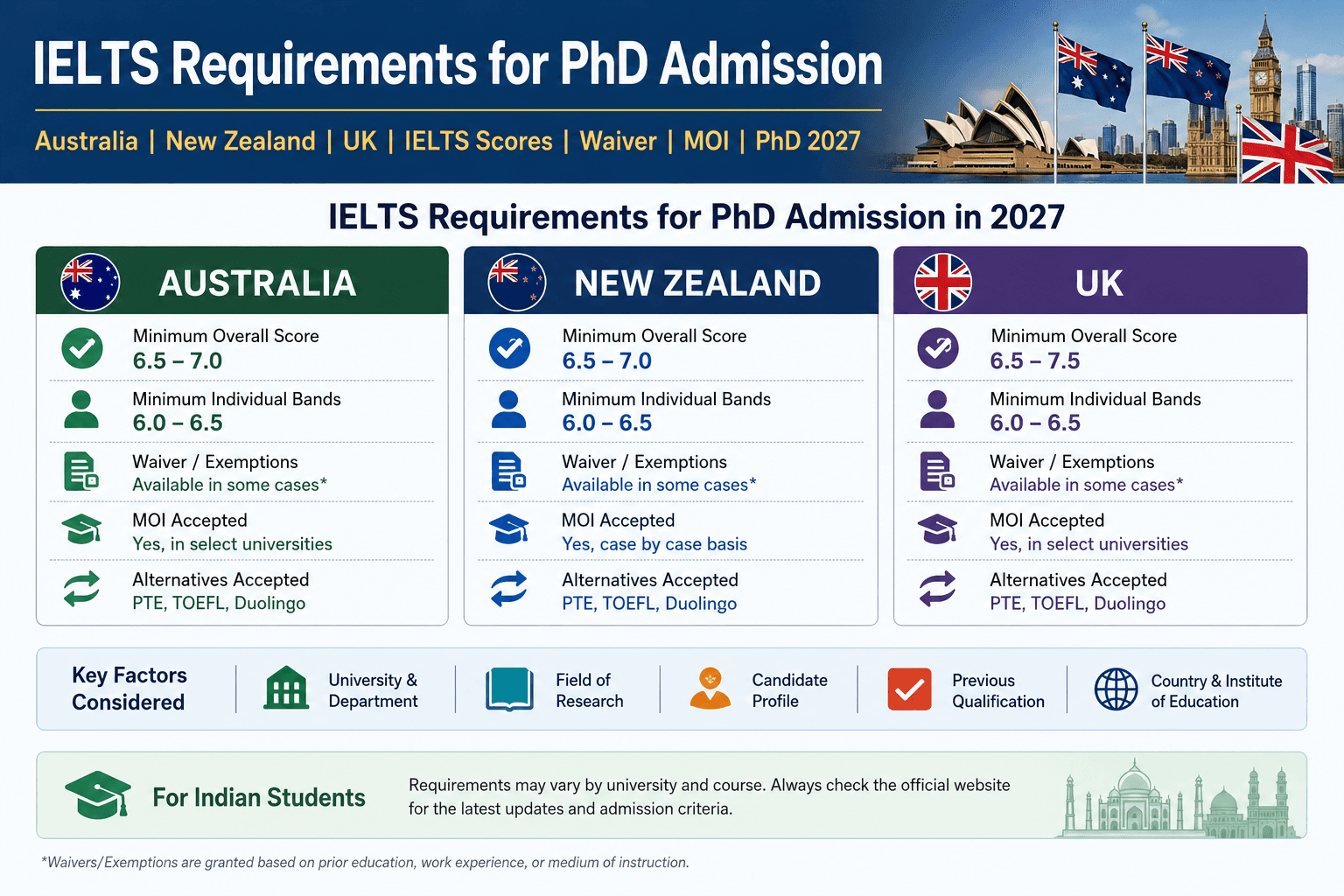
Planning a PhD abroad in 2027? If you are considering Australia, New Zealand or the United Kingdom, understanding the IELTS requirements for PhD admission should be part of your application strategy from the beginning.
For many international and Indian students, questions such as “What IELTS score is required for a PhD?”, “Is IELTS 6.5 enough for PhD admission?”, “Can I apply for a PhD without IELTS?” and “Is MOI accepted instead of IELTS?” become important while shortlisting universities.
There is no single IELTS score applicable to every doctoral programme. However, IELTS Academic 6.5 overall with no band below 6.0 is a common benchmark at a number of universities, particularly in Australia and New Zealand. Requirements in the UK can be higher, with some competitive programmes requiring IELTS 7.0 or 7.5 overall.
For example, the University of Auckland currently states IELTS Academic 6.5 overall with no band below 6.0 for its PhD programme. Oxford’s graduate English requirements are 7.0 overall with at least 6.5 in each component at Standard level and 7.5 overall with at least 7.0 in each component at Higher level.
Cambridge demonstrates why students should check programme-specific requirements rather than relying on country averages. Its PhD in Computer Science currently requires IELTS Academic 7.5 overall and 7.0 in every component.
This EducationMESD guide explains the IELTS requirements for PhD admission in Australia, New Zealand and the UK for 2027, including minimum scores, individual band requirements, IELTS waivers, MOI, alternatives such as TOEFL and PTE, and practical guidance for Indian PhD applicants.
IELTS Requirements for PhD Admission: Quick Answer
If you are searching for the minimum IELTS score for PhD admission, use the following figures only as general planning benchmarks:
| Country | Common IELTS Range for PhD | Typical Individual Band Expectation | Is IELTS 6.5 Often Enough? |
|---|---|---|---|
| Australia | 6.5–7.0+ | Around 6.0–6.5+ | Often |
| New Zealand | 6.5–7.0+ | Around 6.0+ | Often |
| UK | 6.5–7.5+ | Around 6.0–7.0+ | Programme-dependent |
Important: IELTS requirements vary by university, faculty, discipline and individual doctoral programme. Applicants should always verify the latest requirements on the official programme page.
Key takeaway
For students applying across several universities, a practical IELTS target can be:
IELTS Academic 7.0 overall with no band below 6.5
This is not a universal admission requirement, but it may provide broader application flexibility than aiming only for 6.5.
What IELTS Score Is Required for PhD Admission?
There is no universal IELTS requirement for PhD admission abroad.
Universities establish their own English-language requirements, and individual faculties may impose scores higher than the university-wide minimum.
Students may therefore encounter requirements such as:
- IELTS 6.5 overall with no band below 6.0;
- IELTS 7.0 overall with minimum 6.5 components;
- IELTS 7.5 overall with minimum 7.0 components;
- higher Writing requirements for selected disciplines.
Your required IELTS score may depend on:
- university;
- country;
- research discipline;
- faculty;
- doctoral programme;
- previous education;
- professional accreditation;
- English-language exemption rules.
This means two PhD programmes at different universities—or even within different faculties of the same university—may have different English-language requirements.
Why Is IELTS Required for PhD Admission Abroad?
A doctoral degree requires extensive academic communication.
PhD researchers may need to:
- read hundreds of research papers;
- conduct systematic or critical literature reviews;
- write a research proposal;
- communicate with supervisors;
- prepare research reports;
- submit journal manuscripts;
- present research at international conferences;
- participate in academic seminars;
- write a doctoral thesis;
- defend research through an oral examination or viva.
Universities therefore need evidence that international applicants have sufficient academic English proficiency to undertake advanced research.
For PhD admission, applicants normally need IELTS Academic, rather than IELTS General Training.
IELTS Requirements for PhD in Australia 2027
Australia continues to attract international doctoral students because of its research-intensive universities, funding opportunities, global academic reputation and strong doctoral research ecosystem.
For many students researching the IELTS requirements for PhD in Australia, a useful starting benchmark is:
IELTS Academic 6.5 Overall with No Band Below 6.0
However, this is not a national rule.
Individual universities and faculties may require:
- IELTS 7.0 overall;
- 6.5 in individual components;
- higher Writing scores;
- additional professional language requirements.
Therefore, students should verify the English-language requirement for the specific PhD programme, not simply the university’s general postgraduate requirement.
Is IELTS 6.5 Enough for PhD in Australia?
For many Australian doctoral programmes, IELTS 6.5 can be sufficient, particularly where the requirement is 6.5 overall with no individual score below 6.0.
However, IELTS 6.5 does not make an applicant eligible for every programme.
Consider this example.
Applicant A
| Component | Score |
| Listening | 6.5 |
| Reading | 6.5 |
| Writing | 6.0 |
| Speaking | 6.5 |
| Overall | 6.5 |
If the programme requires 6.5 overall with no band below 6.0, the applicant meets the language threshold.
Applicant B
| Component | Score |
| Listening | 7.0 |
| Reading | 7.0 |
| Writing | 5.5 |
| Speaking | 6.5 |
| Overall | 6.5 |
Despite achieving an overall 6.5, Applicant B may not satisfy a programme requiring no component below 6.0.
The lesson is important:
For PhD admission, your overall IELTS score and your individual band scores both matter.
IELTS Requirements for PhD in New Zealand 2027
New Zealand has become an increasingly attractive option for international doctoral students seeking research-intensive universities and internationally recognised PhD qualifications.
A commonly encountered benchmark for PhD admission in New Zealand is:
IELTS Academic 6.5 Overall with No Band Below 6.0
The University of Auckland currently specifies exactly this requirement for its PhD programme: 6.5 overall with no band below 6.0. It also states that students must meet its English-language requirements as a condition of entry.
Typical Planning Benchmark
| IELTS Component | Indicative Score |
| Overall | 6.5 |
| Listening | 6.0+ |
| Reading | 6.0+ |
| Writing | 6.0+ |
| Speaking | 6.0+ |
These scores should be treated as a planning reference rather than a guarantee of eligibility.
Is IELTS 6.5 Enough for PhD in New Zealand?
For many doctoral programmes, IELTS 6.5 may be enough, provided the applicant also satisfies the minimum individual component requirements.
The University of Auckland is a clear example, requiring IELTS Academic 6.5 overall and no component below 6.0 for its PhD.
However, applicants should still check:
University requirement → Faculty requirement → Programme requirement
If the programme-specific requirement is higher, the higher threshold applies.
IELTS Requirements for PhD in the UK 2027
The IELTS requirements for PhD in the UK can be more variable than many students expect.
Applicants may encounter requirements ranging approximately from:
IELTS Academic 6.5 to 7.5+
Highly competitive institutions and programmes requiring substantial academic writing or advanced communication may set higher standards.
Oxford currently uses two graduate English-language levels:
| Oxford English Level | IELTS Overall | Minimum Per Component |
| Standard | 7.0 | 6.5 |
| Higher | 7.5 | 7.0 |
Cambridge provides another strong example. Its current PhD in Computer Science requires:
- IELTS Academic 7.5 overall
- Listening: 7.0
- Reading: 7.0
- Writing: 7.0
- Speaking: 7.0
Its PhD in English similarly lists IELTS 7.5 overall with 7.0 in each component.
This illustrates why students should avoid assuming that IELTS 6.5 will be sufficient for all UK PhD programmes.
Is IELTS 6.5 Enough for PhD in the UK?
Sometimes, but not always.
Some UK doctoral programmes may accept IELTS 6.5, whereas others require:
- 7.0 overall;
- 7.5 overall;
- minimum 6.5 components;
- minimum 7.0 components.
For applicants targeting multiple UK universities, the safest strategy is to determine the highest IELTS requirement among all shortlisted programmes.
For example:
| Shortlisted Programme | IELTS Requirement |
| Programme A | 6.5 |
| Programme B | 7.0 |
| Programme C | 7.0 |
| Programme D | 7.5 |
In this situation, aiming for 7.5 gives the student the greatest flexibility.
Australia vs New Zealand vs UK IELTS Requirements for PhD
Here is a simplified comparison for students planning a PhD abroad in 2027.
| Factor | Australia | New Zealand | UK |
| Common IELTS Range | 6.5–7.0+ | 6.5–7.0+ | 6.5–7.5+ |
| IELTS Academic | Usually | Usually | Usually |
| IELTS 6.5 Often Enough | Yes | Yes | Depends |
| Programme-Specific Requirements | Yes | Yes | Yes |
| Individual Bands Important | Yes | Yes | Yes |
| Higher Writing Requirement Possible | Yes | Yes | Yes |
| IELTS Waiver May Be Available | University-dependent | University-dependent | University-dependent |
| Alternative Tests May Be Accepted | Yes | Yes | Yes |
Which country has the easiest IELTS requirement for PhD?
There is no reliable country-wide answer.
English-language requirements are primarily established by universities and individual programmes rather than by a single national PhD admissions standard.
Applicants should therefore select universities based on research fit, supervisor availability, funding and programme requirements, not IELTS score alone.
IELTS Overall Score vs Individual Band Score
One of the most common mistakes in a PhD application is checking only the overall IELTS score.
Suppose your IELTS result is:
| Component | Score |
| Listening | 7.5 |
| Reading | 7.0 |
| Writing | 5.5 |
| Speaking | 7.0 |
| Overall | 7.0 |
If your university requires:
IELTS 6.5 overall with no component below 6.0
you may still fail to meet the requirement because your Writing score is only 5.5.
Therefore:
A higher overall IELTS score cannot necessarily compensate for an individual component below the programme minimum.
Why Is IELTS Writing Important for PhD Students?
Writing is particularly important at doctoral level.
A PhD student may need to prepare:
- research proposals;
- literature reviews;
- methodology chapters;
- research reports;
- journal manuscripts;
- conference papers;
- thesis chapters;
- responses to peer reviewers.
Universities may therefore impose stricter Writing requirements for programmes involving substantial academic writing.
Students preparing for IELTS should not focus exclusively on their overall band.
IELTS Academic or IELTS General for PhD Admission?
For university-level doctoral admission, students should normally take:
IELTS Academic
IELTS Academic is intended for higher-education and academic contexts.
IELTS General Training is mainly associated with migration, workplace communication and certain non-degree study purposes.
Therefore:
PhD Admission → IELTS Academic
Before booking the examination, confirm which IELTS format your target university accepts.
Can You Apply for a PhD Without IELTS?
Yes, it may be possible to pursue a PhD without submitting IELTS, depending on university policy.
However, “PhD without IELTS” does not generally mean that the English-language requirement disappears.
Instead, a university may allow another form of evidence such as:
- previous qualifying education conducted in English;
- TOEFL;
- PTE Academic;
- Cambridge English qualifications;
- another recognised test;
- an approved exemption or waiver;
- institution-specific evidence of English proficiency.
Eligibility varies considerably.
PhD Without IELTS for Indian Students
Indian students frequently search for PhD abroad without IELTS because many have completed undergraduate or postgraduate degrees entirely in English.
Some universities may recognise prior English-medium education under specific circumstances.
However:
Studying in English does not automatically guarantee an IELTS waiver.
Universities can consider:
- country of previous education;
- institution attended;
- degree level;
- duration of study;
- when the qualification was completed;
- whether teaching and assessment were both conducted in English;
- faculty-specific rules.
Applicants should therefore obtain confirmation from their target university before assuming that IELTS will be waived.
Is MOI Accepted for PhD Admission Abroad?
MOI, or Medium of Instruction, is a document issued by a previous educational institution confirming that a programme was taught in a particular language.
Indian students often use an MOI certificate to demonstrate that their Bachelor’s or Master’s degree was taught in English.
Some universities may recognise previous English-medium education.
Others may still require an approved English test.
Therefore:
MOI acceptance is university-specific and should never be assumed.
Before relying on MOI, check whether the university accepts:
- Indian English-medium qualifications;
- your specific type of degree;
- your institution;
- the date your degree was completed;
- MOI as formal evidence.
What Is an IELTS Waiver for PhD Admission?
An IELTS waiver means an applicant is permitted to satisfy the English-language requirement through another recognised route.
This could be based on:
- previous education;
- an approved qualification;
- country of study;
- institutional policy;
- another English-language test.
A waiver is different from having no English-language requirement.
Universities may still require evidence that applicants possess sufficient academic English proficiency.
Alternatives to IELTS for PhD Admission
Depending on the university, applicants may be able to submit other approved English tests.
Common possibilities include:
TOEFL iBT
TOEFL is accepted by many universities worldwide.
PTE Academic
PTE Academic is recognised by many institutions, particularly in Australia, New Zealand and the UK.
Cambridge C1 Advanced
Some universities accept Cambridge C1 Advanced.
Cambridge C2 Proficiency
Cambridge C2 Proficiency may also satisfy university English-language requirements.
Oxford, for example, currently lists IELTS Academic, Cambridge C1 Advanced and Cambridge C2 Proficiency among its accepted English qualifications, subject to specified score requirements.
Acceptance and scores vary by university.
Can You Contact a PhD Supervisor Before IELTS?
In many cases, yes.
You generally do not need to delay your supervisor search simply because you have not yet completed IELTS.
A practical process is:
Research Area → University → Potential Supervisor → Research Fit → Initial Contact → Research Proposal → IELTS → Formal Application
When contacting a potential PhD supervisor, focus primarily on:
- research alignment;
- academic qualifications;
- research experience;
- publications;
- proposed research idea;
- methodology;
- why you want to work with that supervisor.
Your English-language qualification can then be handled according to the formal admissions requirements.
Is IELTS Required Before Submitting a PhD Application?
Not necessarily in every case.
Some universities may allow students to apply before satisfying the English-language requirement and subsequently make an offer conditional on meeting it.
For example, Cambridge’s Centre of Development Studies states that applicants requiring English-language evidence can initially receive a conditional offer before supplying the required result, although the requirement must ultimately be satisfied.
Policies vary, so always check your specific programme.
What Is a Good IELTS Score for PhD Admission?
There is an important difference between:
Minimum IELTS score
and
Strategic IELTS target
If your shortlisted programmes require between 6.5 and 7.0, targeting:
IELTS 7.0 Overall with No Band Below 6.5
may provide a useful buffer.
For programmes with higher requirements, applicants may need:
IELTS 7.5 Overall with 7.0 in Each Component
Oxford’s Higher level currently uses exactly this benchmark, while several Cambridge doctoral programmes also list 7.5 overall with 7.0 per component.
Is IELTS 7.0 Good for PhD Admission?
Yes. IELTS 7.0 is a strong score for many doctoral programmes, although it does not satisfy every programme.
For example, it meets Oxford’s current Standard level requirement if each component is at least 6.5. However, it would not meet Oxford’s Higher level requirement or Cambridge’s current PhD in Computer Science requirement.
This reinforces an important principle:
The right IELTS score is the score required by your target programme—not an arbitrary global benchmark.
IELTS Score Strategy for Indian PhD Applicants
Students can follow this process before booking IELTS.
Step 1: Select Your Research Area
Define your broad and narrow research interests.
Step 2: Choose Target Countries
Consider Australia, New Zealand, the UK or a combination.
Step 3: Shortlist Universities
Create a shortlist of approximately 5–10 suitable institutions.
Step 4: Identify Potential Supervisors
Assess research alignment by reviewing:
- faculty profiles;
- recent publications;
- ongoing research;
- funded projects;
- research groups.
Step 5: Check IELTS Requirements
Record:
- overall IELTS requirement;
- Writing minimum;
- Reading minimum;
- Listening minimum;
- Speaking minimum.
Step 6: Check IELTS Waiver Rules
Determine whether your previous education may qualify.
Step 7: Check Alternative Tests
Look for:
- TOEFL;
- PTE;
- Cambridge English;
- other approved evidence.
Step 8: Choose the Highest Requirement
If your shortlist ranges from IELTS 6.5 to 7.5, prepare for the highest score.
Recommended IELTS Target for Multiple PhD Applications
Suppose you have the following shortlist:
| University | IELTS Overall | Minimum Component |
| University A | 6.5 | 6.0 |
| University B | 6.5 | 6.0 |
| University C | 7.0 | 6.5 |
| University D | 7.0 | 6.5 |
| University E | 7.5 | 7.0 |
If you genuinely intend to apply to all five, your strategic target should be:
IELTS 7.5 Overall with No Component Below 7.0
Preparing according to the highest requirement reduces the risk of needing another IELTS attempt later.
Does IELTS Score Affect PhD Scholarships?
Usually, IELTS functions mainly as an eligibility requirement, rather than the primary criterion for scholarship selection.
After satisfying the required English threshold, scholarship competitiveness is more likely to depend on:
- academic performance;
- research experience;
- publications;
- research proposal;
- research novelty;
- supervisor alignment;
- recommendation letters;
- academic CV;
- methodology skills;
- scholarship-specific criteria.
Therefore:
IELTS 8.0 does not automatically make an applicant more competitive for a PhD scholarship than an applicant with IELTS 7.0 who has a stronger research profile.
IELTS Requirements for Fully Funded PhD Abroad
Students looking for a fully funded PhD in Australia, New Zealand or the UK should evaluate English-language eligibility alongside funding eligibility.
A competitive application usually requires alignment between:
Research Interest → Research Gap → Supervisor → University → Funding → English Requirement → PhD Application
Potential funding routes may include:
Australia
- Research Training Program-related funding;
- university doctoral scholarships;
- faculty-funded projects;
- externally funded research projects.
New Zealand
- university doctoral scholarships;
- research project funding;
- faculty or school scholarships.
UK
- research council-funded opportunities;
- UKRI-associated doctoral funding;
- doctoral training programmes;
- departmental studentships;
- university scholarships;
- funded research projects.
Meeting IELTS requirements alone does not guarantee funding.
When Should You Take IELTS for PhD Admission 2027?
Students planning a 2027 PhD intake should ideally start checking IELTS requirements early in the application cycle.
9–12 Months Before Applying
Focus on:
- research area;
- country selection;
- university shortlist;
- potential supervisors;
- scholarship research.
6–9 Months Before Applying
Work on:
- supervisor communication;
- research proposal;
- academic CV;
- IELTS preparation.
4–6 Months Before Applying
Complete:
- IELTS test;
- research proposal;
- academic documents;
- recommendation planning;
- scholarship documentation.
2–4 Months Before Deadlines
Focus on:
- IELTS retake if required;
- final applications;
- scholarship submissions;
- remaining supporting documents.
Starting early gives applicants sufficient time to address a low individual band.
Common IELTS Mistakes PhD Applicants Should Avoid
1. Assuming IELTS 6.5 Works Everywhere
Requirements differ considerably.
2. Looking Only at the Overall Score
Individual component scores are equally important.
3. Ignoring Faculty Requirements
A faculty may require more than the university-wide minimum.
4. Taking IELTS General Training
IELTS Academic is normally the relevant test for doctoral admission.
5. Assuming MOI Guarantees an IELTS Waiver
It does not.
6. Preparing Only for the Minimum Score
Targeting a slightly higher score provides flexibility.
7. Ignoring Writing
Writing requirements can be particularly important at PhD level.
8. Booking IELTS Before Shortlisting Universities
Check your target programmes first.
9. Confusing Admission and Visa Requirements
University admissions requirements and immigration requirements are not necessarily identical.
10. Depending on Old Information
IELTS policies can change. Always verify current requirements before applying.
Frequently Asked Questions About IELTS Requirements for PhD Admission
What is the minimum IELTS score for PhD admission?
There is no universal minimum. Students commonly encounter requirements from approximately IELTS 6.5 to 7.5 overall, depending on the university and PhD programme.
Is IELTS 6.5 enough for PhD admission?
It can be sufficient for many programmes, particularly in Australia and New Zealand, but not for all universities.
What IELTS score is required for PhD in Australia?
A common benchmark is IELTS Academic 6.5 overall with no band below 6.0, although individual programmes can require higher scores.
What IELTS score is required for PhD in New Zealand?
Many students encounter requirements around IELTS 6.5 overall with minimum 6.0 components. The University of Auckland currently uses this requirement for its PhD programme.
What IELTS score is required for PhD in the UK?
Requirements vary. Some programmes may accept around 6.5, while highly selective programmes can require 7.0–7.5 or higher.
Is IELTS 7.0 enough for a UK PhD?
For some programmes, yes. Oxford’s current Standard English level is 7.0 overall with 6.5 per component, but its Higher level is 7.5 overall with 7.0 per component.
Can I pursue a PhD abroad without IELTS?
Possibly, if your university accepts another recognised English qualification, previous qualifying education or an approved exemption.
Can Indian students get an IELTS waiver?
Potentially. Eligibility depends entirely on the university’s English-language policy.
Is MOI accepted instead of IELTS?
Some institutions may accept qualifying English-medium education, but MOI is not universally accepted.
Which IELTS is required for PhD admission?
Normally IELTS Academic.
Can I take PTE instead of IELTS for a PhD?
Many universities accept PTE Academic, but acceptance and minimum scores vary.
Can TOEFL replace IELTS for PhD admission?
Many universities accept TOEFL, subject to their current English-language rules.
Can I contact a PhD supervisor without IELTS?
Generally, yes. Supervisor outreach can often begin before completing the English-language test.
Is IELTS required before applying for a PhD?
Not always. Some institutions may issue conditional offers subject to later completion of the English-language requirement.
Does IELTS affect PhD scholarship chances?
IELTS mainly demonstrates language eligibility. Research quality, academic performance, proposal strength and supervisor fit generally matter much more after the English threshold is met.
IELTS Requirements for PhD Admission: Final Comparison
| Question | Australia | New Zealand | UK |
| Common IELTS starting benchmark | 6.5 | 6.5 | 6.5–7.5 |
| 6.5 may be accepted | Frequently | Frequently | Depends |
| 7.0 may be required | Yes | Yes | Frequently in some institutions |
| 7.5 possible | Yes | Yes | Yes |
| IELTS Academic | Usually | Usually | Usually |
| Individual bands matter | Yes | Yes | Yes |
| Waiver possible | Institution-specific | Institution-specific | Institution-specific |
| MOI may be considered | Sometimes | Sometimes | Sometimes |
Final Verdict: What IELTS Score Should You Target for a PhD in 2027?
For students planning a PhD in Australia, New Zealand or the UK in 2027, there is no single IELTS score that guarantees admission.
As a broad planning guide:
Australia: commonly around IELTS 6.5–7.0+
New Zealand: commonly around IELTS 6.5–7.0+
United Kingdom: approximately IELTS 6.5–7.5+, depending strongly on the programme.
A score of IELTS 6.5 overall with no band below 6.0 can satisfy the English requirement for a number of doctoral programmes, particularly in Australia and New Zealand.
However, students applying to several competitive universities should consider aiming for:
IELTS 7.0 Overall with No Band Below 6.5
Applicants targeting universities or programmes with higher English-language requirements may need:
IELTS 7.5 Overall with No Band Below 7.0
Instead of asking only “What is the minimum IELTS score for PhD admission?”, ask:
“What is the highest IELTS requirement among the PhD programmes that match my research interests?”
That question produces a far more effective application strategy.
Your complete PhD roadmap should be:
Research Interest → Research Gap → University → Supervisor → Research Proposal → Funding → IELTS Requirement → Application → Interview → Admission
Planning a PhD Abroad in 2027?
EducationMESD provides guidance for Indian students and research aspirants planning doctoral study internationally.
Explore our detailed resources on:
- PhD Abroad for Indian Students in 2027
- PhD in Australia for Indian Students
- Fully Funded PhD in Australia
- PhD in New Zealand for Indian Students
- PhD in the UK for Indian Students
- PhD in Australia vs New Zealand vs UK
- PhD Abroad Without GRE
- How to Find and Contact a PhD Supervisor Abroad
- How to Write a Research Proposal for PhD Admission Abroad
A successful PhD application is not built around IELTS alone.
It is built around:
Strong Research Fit + Right Supervisor + Strong Research Proposal + Academic Profile + Funding Strategy + Correct Application Timing