
How to Write a Research Proposal for PhD Admission Abroad in 2027: Format, Sample, Examples & Complete Guide
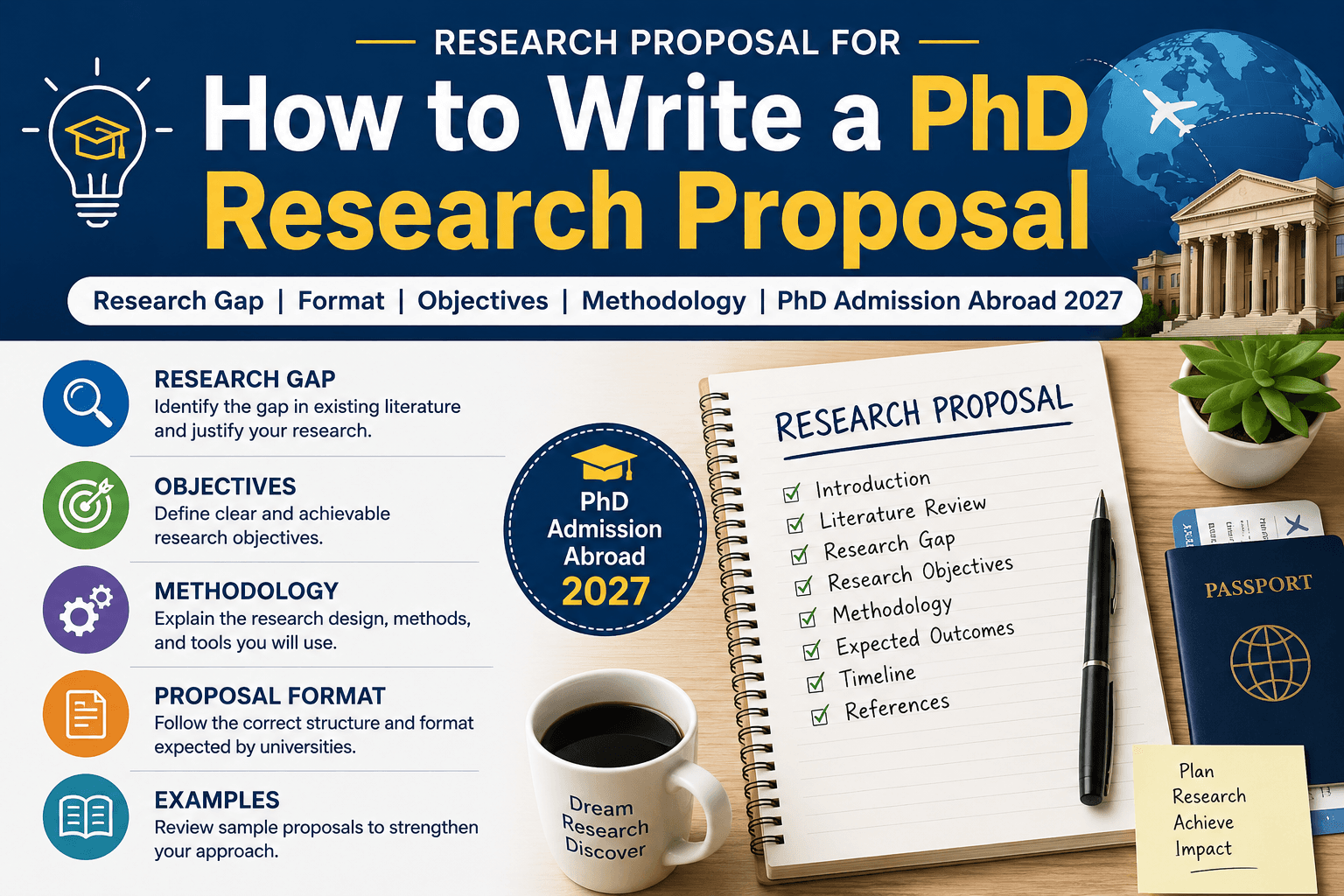
Are you planning to apply for a PhD abroad in 2027? Writing a strong research proposal for PhD admission abroad can be one of the most important parts of your doctoral application.
A PhD research proposal explains what you want to research, why the topic matters, what research gap exists, how you plan to conduct the study, and what original contribution your research could make.
For students applying for PhD programmes in the UK, Australia, New Zealand, Germany, Canada, Europe and other international destinations, the proposal can also help universities determine whether your research fits the expertise of a potential PhD supervisor.
In this complete EducationMESD guide, you will learn:
- How to write a research proposal for PhD admission abroad
- Correct PhD research proposal format
- How to identify a research gap
- How to write research aims and objectives
- How to develop research questions
- How to write the research methodology
- PhD research proposal examples
- Research proposal template
- Common mistakes to avoid
- How to make your PhD proposal stand out
- FAQs about PhD research proposals
Students who are still planning their overall application can first read our PhD abroad for Indian students in 2027 guide.
Quick Answer: How Do You Write a Research Proposal for PhD Admission Abroad?
To write a strong research proposal for PhD admission abroad, follow this sequence:
Research Topic → Research Problem → Literature Review → Research Gap → Research Aim → Objectives → Research Questions → Methodology → Expected Contribution → Timeline
Your proposal should demonstrate that the research is original, academically relevant, methodologically sound, feasible and aligned with a suitable PhD supervisor.
What Is a Research Proposal for PhD Admission Abroad?
A research proposal for PhD admission abroad is a formal academic document outlining the research project you intend to undertake during your doctoral programme.
It should clearly answer five questions:
- What do you want to research?
- Why is the research important?
- What is missing from existing literature?
- How will you conduct the research?
- What new knowledge could your research contribute?
A research proposal is therefore not simply a description of an interesting topic.
It should demonstrate your ability to:
- Identify a significant research problem
- Review academic literature critically
- Identify an original research gap
- Develop focused research questions
- Select appropriate research methods
- Design a feasible doctoral project
- Explain the originality of your study
- Demonstrate research-supervisor fit
Research proposal requirements are not identical across universities. The University of Oxford advises applicants to check the individual course page for required content, assessment criteria and word limits before preparing the proposal.
Why Is a PhD Research Proposal Important?
A strong PhD research proposal allows universities and prospective supervisors to evaluate your readiness for doctoral research.
Your proposal can demonstrate:
Academic Knowledge
Do you understand the major concepts, theories and debates within your proposed research area?
Research Capability
Can you identify a research problem and transform it into a structured academic investigation?
Originality
Does the proposed research have the potential to contribute new knowledge?
Methodological Understanding
Do you know how to answer your research questions using appropriate research methods?
Research Feasibility
Can the proposed project realistically be completed within the available time and resources?
Supervisor Fit
Is there a faculty member whose expertise aligns with your proposed research?
These factors make the research proposal particularly important for students targeting a research-based PhD abroad.
A strong proposal should align with an appropriate academic; see our guide on how to find and contact a PhD supervisor abroad.
PhD Research Proposal Format
Although individual universities may have their own requirements, a standard PhD research proposal format generally includes:
| Section | What to Include |
|---|---|
| Research Title | Clear and focused proposed topic |
| Abstract | Short overview of the study |
| Introduction | Background and importance |
| Research Problem | Specific problem being investigated |
| Literature Review | Existing research and academic debate |
| Research Gap | What remains unanswered |
| Research Aim | Overall purpose |
| Research Objectives | Specific research activities |
| Research Questions | Questions the research will answer |
| Hypotheses | Where applicable |
| Theoretical Framework | Relevant theories or concepts |
| Methodology | Research design and analysis |
| Ethics | Ethical considerations |
| Expected Contribution | Originality and value |
| Timeline | Proposed research schedule |
| References | Academic sources cited |
Always follow the exact research proposal guidelines given by the university or department.
University of Edinburgh guidance recommends that research proposals address areas such as the title and abstract, existing literature, objectives, methodology, ethical considerations and the overall significance of the proposed research.
University of Edinburgh – How to Write a Good Postgraduate Research Proposal
How to Write a Research Proposal for PhD Admission Abroad Step by Step
Step 1: Select a Focused PhD Research Topic
Start with an area that genuinely interests you and matches your academic or professional background.
However, avoid extremely broad topics.
Weak Topic
Artificial Intelligence in Healthcare
This is a research area rather than a focused PhD topic.
Better Topic
Explainable Artificial Intelligence for Medical Diagnosis
More Focused PhD Topic
Explainable Federated Deep Learning for Privacy-Preserving Brain Tumour Segmentation Using Multi-Institutional MRI Data
A strong topic should indicate:
- Main concept or technology
- Research problem
- Context
- Population or dataset where relevant
- Expected direction of investigation
Step 2: Write a Strong PhD Research Proposal Title
Your research title should be concise, informative and academically meaningful.
A useful title formula is:
Main Concept + Research Problem/Relationship + Context
AI Research Example
Explainable Federated Learning for Privacy-Preserving Brain Tumour Segmentation
Marketing Research Example
Brand Activism and Consumer Purchase Intention: The Mediating Role of Brand Authenticity
Education Research Example
Explainable Machine Learning for Predicting Student Dropout in Online Higher Education
Finance Research Example
Machine Learning-Based Credit Risk Prediction for Digital Lending Platforms
Your PhD proposal title does not necessarily have to remain unchanged throughout your doctorate.
Step 3: Write the Research Proposal Abstract
If required, the abstract should summarise the proposed research in a few concise paragraphs.
Use this structure:
Research Problem → Research Gap → Aim → Methodology → Expected Contribution
PhD Research Proposal Abstract Template
This proposed research investigates [research problem]. Although previous studies have examined [existing knowledge], limited research has addressed [research gap]. Therefore, the study aims to [research aim]. Using [research methodology], the research will analyse [population/data]. The findings are expected to contribute to [theoretical, methodological, empirical or practical contribution].
Avoid adding information in the abstract that does not appear in the main proposal.
Step 4: Write a Strong Introduction
The introduction should establish the importance of the proposed study.
A useful structure is:
Broad Research Context → Specific Problem → Existing Knowledge → Limitation → Research Gap → Proposed Study
Avoid generic statements such as:
Technology is developing rapidly.
Instead, move directly toward the research issue.
Example
Deep-learning models have demonstrated substantial potential in medical-image analysis. However, conventional centralised approaches often require healthcare institutions to transfer sensitive patient information, creating concerns regarding privacy, data governance and regulatory compliance.
This immediately establishes a meaningful research context.
Step 5: Define the Research Problem
A research topic and a research problem are different.
Topic
Federated Learning in Healthcare
Research Problem
Centralised medical AI systems may require hospitals to pool sensitive patient data, while federated-learning alternatives can experience reduced performance when participating institutions have highly heterogeneous datasets.
Your research problem should answer:
- What is happening?
- What is problematic?
- Why does the problem matter?
- What remains unresolved?
- Why should researchers investigate it?
Step 6: Conduct a Critical Literature Review
The literature review shows that you understand the existing academic research surrounding your topic.
Avoid simply describing one paper after another.
Weak Approach
Author A studied artificial intelligence. Author B examined machine learning. Author C investigated deep learning.
Better Approach
Existing studies demonstrate that deep-learning architectures can achieve high diagnostic accuracy in medical-image analysis. However, most conventional approaches rely on centralised data, while evidence regarding privacy-preserving distributed learning remains inconsistent across heterogeneous healthcare environments.
The stronger version:
- Synthesises previous findings
- Identifies patterns
- Highlights limitations
- Creates a pathway toward the research gap
The University of Cambridge recommends that a research proposal clearly explain the research questions and aims, how the project fits within the field, why the research is important, the proposed methodology, scope and timescale. Cambridge also stresses that the project should be valuable, achievable and compatible with available supervision or research groups.
What Should a PhD Literature Review Cover?
Your literature review should examine:
Existing Knowledge
What is already known?
Major Theories
Which theoretical frameworks have been used?
Existing Methods
What research methodologies dominate the literature?
Contradictory Findings
Where do previous studies disagree?
Contexts
Which countries, populations, industries or datasets have been examined?
Limitations
What weaknesses repeatedly appear?
Future Research Directions
What remains unresolved?
Step 7: Identify a Strong Research Gap
The research gap for PhD admission is one of the most important parts of your proposal.
A research gap describes:
An important theoretical, empirical, methodological, contextual or practical issue that existing research has not adequately resolved.
Types of Research Gaps for PhD Research
Theoretical Gap
Existing theories do not adequately explain a phenomenon.
Example
Traditional technology-adoption theories may explain intention to use AI but may not sufficiently capture trust in autonomous decision-making systems.
Empirical Gap
Existing results are insufficient, inconsistent or contradictory.
Example
Some studies report that brand activism improves purchase intention, while others identify negative consumer reactions.
Methodological Gap
Previous research may rely heavily on one methodological approach.
Example
Most existing studies use cross-sectional surveys, while experimental and longitudinal evidence remains limited.
Contextual Gap
Existing theories or findings may not have been adequately examined within a theoretically important context.
Example
Research conducted primarily in developed Western markets may not fully explain consumer responses within rapidly digitalising emerging economies.
Population Gap
Important groups may remain under-researched.
Examples include:
- International students
- Rural populations
- Older adults
- Healthcare professionals
- Small-business owners
- First-generation university students
Technological Gap
Emerging technologies can create new unanswered research questions.
Examples include:
- Generative AI
- Large Language Models
- Explainable AI
- Federated Learning
- Digital Twins
- Edge AI
- Autonomous Systems
Practical Gap
Academic research exists, but a significant real-world problem remains unresolved.
Example
Medical AI models may achieve high accuracy but still face limited clinical adoption because healthcare professionals cannot adequately interpret model predictions.
How to Find a Research Gap for PhD Admission
Follow this research process:
Search → Read → Compare → Categorise → Identify Limitations → Identify Contradictions → Validate the Gap
Start with:
- Recent journal articles
- Systematic literature reviews
- Meta-analyses
- Review papers
- Highly cited research
- Recent conference papers
- Limitations sections
- Future-research sections
- Conflicting empirical findings
Do not simply copy statements such as:
More research is required.
Ask:
What exactly remains unknown, and why does it matter?
That question can help transform a simple literature limitation into a meaningful doctoral research gap.
Step 8: Write the Research Aim
Your research aim states the overall purpose of the proposed study.
Usually, one overarching aim is sufficient.
Example
To develop and evaluate an explainable federated deep-learning framework for privacy-preserving brain tumour segmentation across heterogeneous healthcare institutions.
A strong research aim should be:
- Specific
- Clear
- Achievable
- Researchable
- Connected to the research gap
Step 9: Write Research Objectives for Your PhD Proposal
Research objectives divide the research aim into specific tasks.
Good verbs include:
- Analyse
- Assess
- Compare
- Develop
- Determine
- Evaluate
- Examine
- Explore
- Investigate
- Test
- Validate
Example PhD Research Objectives
The proposed study aims to:
- Develop a federated deep-learning framework for brain tumour segmentation.
- Examine the impact of heterogeneous data on segmentation performance.
- Compare alternative federated aggregation strategies.
- Integrate explainable AI techniques into the proposed framework.
- Evaluate the framework in terms of accuracy, efficiency and interpretability.
How Many Research Objectives Should a PhD Proposal Have?
There is no universal rule.
However, three to five focused research objectives can often provide a manageable structure for a PhD proposal.
More important than the number is the relationship:
Research Gap → Aim → Objectives → Research Questions → Methodology
Every section should logically connect.
Step 10: Develop Strong Research Questions
Research questions should emerge directly from the gap and objectives.
Examples
RQ1: How does heterogeneous client-data distribution affect federated brain tumour segmentation performance?
RQ2: Which federated aggregation strategy provides the strongest balance between segmentation accuracy and computational efficiency?
RQ3: To what extent can explainable AI improve the interpretability of federated medical-image segmentation models?
Good research questions should be:
- Clear
- Specific
- Researchable
- Original
- Relevant
- Answerable using the proposed methodology
Step 11: Develop Research Hypotheses Where Required
Not all PhD proposals require hypotheses.
Hypotheses are common in quantitative research areas such as:
- Marketing
- Management
- Finance
- Economics
- Psychology
- Information systems
- Behavioural sciences
Example
H1: Perceived brand authenticity positively influences consumer trust.
H2: Consumer trust positively influences purchase intention.
H3: Consumer trust mediates the relationship between brand authenticity and purchase intention.
Qualitative research may rely primarily on research questions.
Step 12: Develop the Theoretical or Conceptual Framework
A PhD proposal may need to identify the theories underpinning the research.
Depending on your discipline, examples include:
- Social Identity Theory
- Signalling Theory
- Stakeholder Theory
- Technology Acceptance Model
- UTAUT
- Diffusion of Innovation Theory
- Institutional Theory
- Resource-Based View
- Stimulus-Organism-Response Framework
Do not simply list theories.
Explain:
- What the theory proposes
- Why it is relevant
- What relationships it explains
- How previous studies have used it
- How your research may test, extend or challenge it
Step 13: Write the PhD Research Methodology
The research methodology for a PhD proposal explains how the research questions will be answered.
Depending on your discipline, the methodology may include the following.
Research Philosophy
Where relevant:
- Positivism
- Interpretivism
- Pragmatism
- Critical Realism
Research Approach
- Deductive
- Inductive
- Abductive
Research Design
- Quantitative
- Qualitative
- Mixed Methods
- Experimental
- Cross-sectional
- Longitudinal
- Case Study
- Computational Research
Step 14: Define the Research Population or Dataset
Clearly explain who or what will be investigated.
Examples include:
- Students
- Consumers
- Employees
- Healthcare professionals
- Organisations
- Medical images
- Financial records
- Social-media data
- IoT sensor data
- Public datasets
Step 15: Select the Sampling Method
Depending on your research design, you may use:
- Simple random sampling
- Stratified sampling
- Cluster sampling
- Purposive sampling
- Convenience sampling
- Snowball sampling
- Respondent-driven sampling
- Multi-stage sampling
Explain why the selected sampling method is appropriate.
Step 16: Determine the Sample Size
Avoid selecting a sample size arbitrarily.
Possible approaches include:
- Statistical power analysis
- Population-based calculations
- Methodological requirements
- Data saturation for qualitative research
For computational research, explain:
- Dataset size
- Training-validation-test split
- Number of experiments
- External validation
- Number of federated clients where relevant
Step 17: Explain Data Collection
Possible methods include:
- Questionnaires
- Interviews
- Focus groups
- Experiments
- Observations
- Secondary datasets
- Clinical datasets
- Organisational records
- Government databases
- Sensors
- Digital platforms
Your proposal should demonstrate that the required data is realistically accessible.
Step 18: Explain Data Analysis
Choose analytical techniques according to your research questions.
Quantitative Research
Possible methods include:
- Descriptive statistics
- Correlation
- Regression
- ANOVA
- Structural Equation Modelling
- PLS-SEM
- Time-series analysis
- Statistical hypothesis testing
Qualitative Research
Possible methods include:
- Thematic analysis
- Content analysis
- Narrative analysis
- Grounded theory
- Discourse analysis
AI and Computer Science Research
Possible methods include:
- Machine learning
- Deep learning
- Federated learning
- Benchmarking
- Ablation studies
- Explainable AI
- Statistical significance testing
- Computational efficiency analysis
The core principle is:
Every major research question should have a clear method through which it can be answered.
Step 19: Address Validity, Reliability and Research Quality
Where applicable, explain how you will ensure methodological quality.
Quantitative Research
Consider:
- Reliability
- Construct validity
- Convergent validity
- Discriminant validity
- Internal validity
- External validity
Qualitative Research
Consider:
- Credibility
- Dependability
- Confirmability
- Transferability
AI and Computational Research
Consider:
- Cross-validation
- External validation
- Statistical testing
- Generalisability
- Robustness
- Reproducibility
Step 20: Address Research Ethics
Research ethics are particularly important when research involves:
- Human participants
- Children
- Patients
- Personal information
- Medical records
- Sensitive datasets
- Biometric information
- Social-media users
Ethical considerations may include:
- Informed consent
- Confidentiality
- Anonymity
- Secure data storage
- Participant withdrawal
- Data protection
- Ethical approval
- Responsible AI use
Step 21: Explain the Expected Contribution to Knowledge
A PhD should normally make an original contribution to knowledge.
Ask:
What will researchers understand after this PhD that they do not adequately understand now?
Your contribution might be:
Theoretical Contribution
Testing, extending, integrating or challenging existing theory.
Methodological Contribution
Developing a new:
- Algorithm
- Framework
- Model
- Measurement scale
- Research technique
Empirical Contribution
Providing new evidence about an unresolved problem.
Contextual Contribution
Examining an important theoretical relationship within a new context.
Practical Contribution
Providing useful findings for:
- Governments
- Policymakers
- Businesses
- Universities
- Healthcare organisations
- Engineers
- Communities
Step 22: Demonstrate Research Feasibility
Your proposed project must be ambitious enough for doctoral research but realistic enough to complete.
Consider:
- Data availability
- Participant access
- Research facilities
- Ethical approval
- Computational resources
- Funding
- Software
- Equipment
- Research skills
- Supervisor expertise
- Available time
A focused and feasible research project is generally stronger than an extremely broad project.
Step 23: Prepare a PhD Research Timeline
A timeline demonstrates that you have considered how the project can be completed.
Example 3-Year PhD Research Timeline
| Period | Proposed Activity |
| Months 1–6 | Literature review and research-gap refinement |
| Months 7–9 | Theoretical framework and methodology |
| Months 10–12 | Pilot study and ethics approval |
| Months 13–20 | Data collection or experimentation |
| Months 21–25 | Data analysis |
| Months 26–29 | Validation and interpretation |
| Months 30–33 | Thesis chapters and research papers |
| Months 34–35 | Thesis revision |
| Month 36 | Final submission and viva preparation |
Adapt this timeline according to the university and programme duration.
Step 24: Add Strong Academic References
Prioritise:
- Peer-reviewed journal articles
- Systematic reviews
- Meta-analyses
- Seminal theoretical studies
- Recent high-quality research
- Academic books
- Reputable conference proceedings
- Authoritative institutional reports
Avoid relying primarily on blogs or unverified websites.
Most importantly:
Never include a reference that you have not personally verified.
PhD Research Proposal Template
Here is a simple template applicants can follow.
Proposed Research Title
Write a clear working title.
1. Abstract
Summarise:
Problem → Gap → Aim → Methodology → Contribution
2. Introduction
Introduce the research area and explain its importance.
3. Research Problem
Clearly define the problem.
4. Literature Review
Critically synthesise previous academic research.
5. Research Gap
Identify what remains unresolved.
6. Research Aim
State the overall research purpose.
7. Research Objectives
List focused objectives.
8. Research Questions
State the questions the PhD will answer.
9. Hypotheses
Include where appropriate.
10. Theoretical Framework
Explain relevant theoretical foundations.
11. Research Methodology
Discuss:
- Research design
- Population
- Sampling
- Data collection
- Data analysis
- Research quality
12. Ethical Considerations
Discuss relevant ethical issues.
13. Expected Contribution
Explain what will be new.
14. Research Timeline
Provide an achievable schedule.
15. References
Include all cited academic sources.
PhD Research Proposal Example
Here is a simplified example showing how the sections connect.
Research Area
Artificial Intelligence in Healthcare
Research Topic
Federated Learning for Medical Image Analysis
Research Problem
Centralised AI systems may require hospitals to combine sensitive patient data.
Research Gap
Existing federated-learning methods can experience performance degradation under heterogeneous institutional data, while model interpretability remains insufficiently explored.
Research Aim
To develop an explainable federated-learning framework for privacy-preserving medical-image analysis.
Research Objectives
- Develop a federated-learning framework.
- Evaluate heterogeneous client-data distributions.
- Compare aggregation strategies.
- Integrate explainable AI.
- Assess model accuracy, efficiency and interpretability.
Research Question
How does heterogeneous client-data distribution affect federated medical-image model performance?
Methodology
Multi-client federated-learning experiments using medical-imaging datasets, explainability techniques and statistical model comparison.
Expected Contribution
A privacy-preserving and interpretable medical AI framework suitable for heterogeneous healthcare environments.
The alignment is:
Problem → Research Gap → Aim → Objectives → Research Questions → Methodology → Contribution
How Long Should a PhD Research Proposal Be?
There is no universal PhD research proposal word limit.
The required length depends on:
- University
- Department
- Discipline
- Research programme
- Funding scheme
- Scholarship requirements
Some programmes may ask for a short proposal, while others require a much more detailed document.
Always check:
- Word limit
- Page limit
- Required headings
- Proposal template
- Referencing style
- Font and spacing
- Whether references count toward the word limit
- Whether appendices are permitted
Research Proposal for PhD in the UK
Students planning a PhD in the UK may be asked to submit a detailed research proposal, particularly when applying with their own research idea.
A strong UK PhD proposal should generally demonstrate:
- Research originality
- Strong literature understanding
- Clear research gap
- Focused questions
- Appropriate methodology
- Feasibility
- Supervisor alignment
For admission, scholarships and UKRI funding, read our complete PhD in UK for Indian students guide.
Research Proposal for PhD in Australia
For students applying for a PhD in Australia, research-supervisor alignment is particularly important.
Applicants should investigate:
- Potential supervisors
- Research centres
- University research strengths
- Laboratory facilities
- Funding
- Scholarship opportunities
- Research Training Program opportunities
Students targeting funding can also explore fully funded PhD in Australia for Indian students.
Research Proposal for PhD in New Zealand
Students targeting a PhD in New Zealand should focus on:
- Originality
- Research feasibility
- Academic significance
- Methodological quality
- Supervisor fit
- Funding opportunities
Applicants can also review PhD in New Zealand for Indian students for fees, scholarships and application planning.
Research Proposal for PhD in Germany and Europe
European PhD structures vary.
Students may encounter:
- Individual PhD programmes
- Structured doctoral programmes
- Advertised research positions
- Funded project-based PhDs
- Doctoral training networks
Some programmes require applicants to propose their own project, whereas others ask candidates to apply for an existing research position.
Research Proposal vs Statement of Purpose
A research proposal and Statement of Purpose (SOP) are different.
| PhD Research Proposal | Statement of Purpose |
| Focuses on proposed research | Focuses on the applicant |
| Identifies a research problem | Describes academic background |
| Identifies a research gap | Explains motivation |
| Includes research questions | Discusses career goals |
| Describes methodology | Explains programme interest |
| Explains contribution | Demonstrates applicant-programme fit |
Both documents may be important, but they serve different purposes.
Should You Contact a PhD Supervisor Before Writing Your Proposal?
Where the university encourages prospective-supervisor contact, doing so can be useful.
A professor may help you understand:
- Whether the topic fits their expertise
- Whether the project is feasible
- Whether facilities are available
- Whether required data can be accessed
- Whether they are accepting PhD students
- Whether funding opportunities exist
Before contacting a professor, review:
- Faculty profile
- Research interests
- Recent publications
- Current projects
- Research laboratory or centre
- Supervision interests
Your approach should demonstrate:
Your Research Interest → Professor’s Expertise → Research Fit
Should You Use the Same PhD Proposal for Every University?
Avoid submitting an identical generic proposal everywhere.
Your core idea can remain similar, but adapt the proposal according to:
- Supervisor expertise
- Departmental research strengths
- Available facilities
- Research centres
- Available datasets
- Funding priorities
- Programme requirements
Customisation can demonstrate genuine research fit.
Applicants should avoid treating one proposal as a universal document. Cambridge advises candidates applying to more than one research course to submit a proposal tailored to the requirements of each individual application.
Can AI Be Used to Write a PhD Research Proposal?
AI tools may assist with:
- Brainstorming
- Creating initial outlines
- Improving language
- Organising concepts
- Developing search terms
- Grammar checking
However, applicants should not use AI to replace their own academic reasoning.
Never use AI to:
- Fabricate references
- Invent theories
- Generate fake datasets
- Fabricate results
- Invent a research gap
- Misrepresent existing research
You should be able to explain and defend every section of your proposal during a PhD interview or supervisor discussion.
Common Mistakes in a PhD Research Proposal
Choosing a Topic That Is Too Broad
A broad topic makes it difficult to demonstrate originality and feasibility.
Confusing a Topic with a Research Gap
A topic tells readers what you want to study.
A research gap explains what is missing from existing knowledge.
Writing a Descriptive Literature Review
Use:
Compare → Contrast → Synthesise → Critique → Identify Gap
Claiming a Gap Without Evidence
Avoid unsupported statements such as:
Nobody has studied this topic.
Including Too Many Objectives
Too many objectives may make a PhD project unrealistic.
Poor Alignment
Your proposal should follow:
Research Gap → Aim → Objectives → Questions → Methodology
Weak Methodological Justification
Explain why each method is appropriate.
Ignoring Feasibility
Consider time, resources, funding, data and ethics.
Ignoring Supervisor Fit
A good proposal still needs appropriate academic supervision.
Using Unverified References
Verify every source before submission.
How to Make a PhD Research Proposal Stand Out
A strong proposal combines the following:
Clear Research Problem
The problem has academic or practical importance.
Evidence-Based Research Gap
The gap is supported by literature.
Originality
The proposed research adds meaningful new knowledge.
Focused Research Questions
Questions are clear and answerable.
Strong Theoretical Foundation
Relevant academic theory supports the research.
Appropriate Methodology
Methods match the questions.
Feasibility
The project can realistically be completed.
Strong Supervisor Fit
The topic aligns with available academic expertise.
A useful formula is:
Research Problem + Research Gap + Originality + Strong Methodology + Feasibility + Supervisor Fit = Competitive PhD Proposal
PhD Research Proposal Checklist
Before submitting your research proposal, check:
- Research title is focused and clear.
- Research problem is clearly defined.
- Literature review critically analyses previous research.
- Research gap is evidence-based.
- Research aim is clear.
- Objectives are specific and achievable.
- Research questions align with objectives.
- Theoretical framework is appropriate.
- Methodology is justified.
- Sample or dataset is realistic.
- Data-analysis methods match the research questions.
- Ethical considerations are addressed.
- Expected contribution is clearly stated.
- Research timeline is realistic.
- Proposal aligns with prospective supervisor expertise.
- University-specific instructions are followed.
- References are genuine and correctly formatted.
- Proposal has been proofread.
- You can explain every section during a PhD interview.
Frequently Asked Questions About PhD Research Proposals
How do I write a research proposal for PhD admission abroad?
Choose a focused topic, review relevant literature, define the research problem, identify a meaningful research gap, develop your aim and objectives, formulate research questions, select appropriate methods, explain the expected contribution and demonstrate feasibility.
What is the best PhD research proposal format?
A typical format includes a title, abstract, introduction, research problem, literature review, research gap, aim, objectives, research questions, theoretical framework, methodology, ethics, expected contribution, timeline and references.
How do I find a research gap for a PhD?
Analyse recent journal articles, systematic reviews, meta-analyses, limitations, contradictory findings and future-research recommendations. Identify an important theoretical, empirical, methodological, contextual or practical issue that remains unresolved.
How many research objectives should a PhD proposal have?
There is no fixed number, but three to five focused objectives can often provide a manageable structure. The objectives should directly support the overall research aim.
How many research questions should a PhD proposal contain?
There is no universal rule. A small number of closely connected, researchable questions is generally stronger than many unrelated questions.
How long should a research proposal for PhD admission be?
The word count varies by university and programme. Applicants should always follow the exact departmental requirements.
Is a research proposal compulsory for PhD admission abroad?
Not always. Some universities offer predefined or funded PhD projects where candidates apply to an existing project rather than submitting an independent proposal.
Can I use the same research proposal for different universities?
You can retain the same core research idea, but customise the proposal to reflect each university’s requirements, supervisor expertise, facilities and research priorities.
Should I contact a professor before applying for a PhD?
Where the programme encourages supervisor contact, approaching a relevant professor can help establish research fit and supervision availability.
Can a PhD research topic change after admission?
Yes. The original proposal represents the initial direction of the project, and the topic, questions or methods may evolve as the research develops.
What makes a PhD research proposal successful?
A successful proposal demonstrates:
A significant research problem + Clear gap + Original contribution + Strong questions + Appropriate methodology + Feasible research plan + Supervisor fit
Final Thoughts: Writing a Successful Research Proposal for PhD Admission Abroad
A strong research proposal for PhD admission abroad is not about using unnecessarily complicated academic language.
It is about presenting a clear and convincing research argument.
Your proposal should follow this logical pathway:
Research Area → Research Problem → Literature Review → Research Gap → Research Aim → Objectives → Research Questions → Methodology → Contribution → Feasibility
By the end of your proposal, a prospective supervisor should understand:
- What you want to research
- Why the topic matters
- What is missing from existing research
- How you plan to investigate the problem
- What new knowledge your study could contribute
- Whether the project is realistic
- Why your proposed research fits their expertise
Students planning PhD admission abroad in 2027 should begin developing their research proposal well before application deadlines.
A strong proposal can also support:
- PhD supervisor communication
- Fully funded PhD applications
- Scholarship applications
- PhD interviews
- Academic publications
- Long-term doctoral research planning
For research-based PhD applications, focus on achieving the strongest alignment:
Research Interest → Research Gap → Supervisor → University → Funding → Research Proposal → PhD Application
Related EducationMESD Guides
To strengthen internal SEO and create a PhD Abroad topical cluster, link naturally to the following EducationMESD articles.
PhD Abroad for Indian Students in 2027: Complete Application Guide
Recommended Anchor:
PhD abroad for Indian students
How to Find and Contact a PhD Supervisor Abroad
Recommended Anchor:
how to find and contact a PhD supervisor abroad
Fully Funded PhD in Australia for Indian Students
Recommended Anchor:
fully funded PhD in Australia
PhD in the UK for Indian Students
Recommended Anchor:
PhD in UK for Indian students
PhD in New Zealand for Indian Students
Recommended Anchor:
PhD in New Zealand for Indian students
PhD in Australia vs New Zealand vs UK
Recommended Anchor:
Australia vs New Zealand vs UK for PhD
EducationMESD PhD Abroad Guidance
Applying for a PhD abroad involves more than selecting a university.
Students need to align:
Research Topic → Research Gap → Research Proposal → Supervisor → University → Funding → Application
EducationMESD provides guidance for students exploring:
- PhD admission abroad
- Fully funded PhD programmes
- PhD scholarships
- Research supervisors
- Research proposal preparation
- International doctoral applications
If you are preparing for a PhD abroad in 2027, start early, develop a focused research idea and prioritise research-supervisor-university fit rather than university ranking alone.
Explore EducationMESD for more PhD abroad guides, scholarship information and international admission resources.